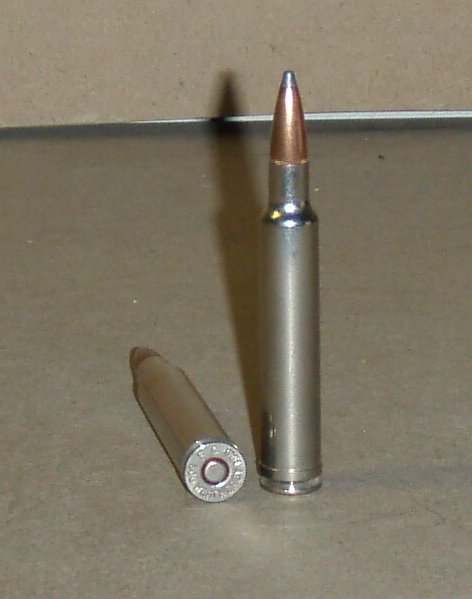
If a hunter were to own just one gun, to have just one caliber, what should it be? This long-debated question has undoubtedly been the subject of countless hours of campfire discussion for more than a century. Tales of hunting elephant with a .22, or a squirrel with a bazooka find their way into folklore. Of course just because we can do something doesn’t mean we should. Using adequate firepower capable of making the shots we encounter and cleanly putting game down is our responsibility as ethical hunters. As hunters we know that the pursuit and the kill bring us closer to the animal. The respect fostered in this relationship requires us to make the best possible choices in equipment.
Factors determining the best all-around caliber are many. First and foremost is the disclaimer that the absolute best caliber for any hunter is the one that they are most accurate with. Without a well-placed shot, everything else written here is meaningless. Beyond shot placement, the primarily factor informing caliber choice is the species a hunter intends to pursue. The answer will certainly vary between a New Mexico varmint hunter and those hunting a Maine Black Bear. This article will focus on best all-around caliber choice for big game around the world, with the exception of dangerous game.
In order to qualify as a well-rounded caliber, it must be able to reach out across ridges for mountain goat, push a heavy bullet in the cover of moose country, and deliver enough energy down range to drop an Eland. The ideal would be a long, flat shooting caliber with the ability to deliver a range of bullets from 130gr to 220gr. While several cartridge families fit the criteria, few do it as well as the .300 magnums.
The surge in popularity of the .300 magnums, and development of several new ones, shows the increasing awareness that hunters have of their performance. Available .300 magnum calibers include the Holland & Holland (H&H), Winchester (WIN), Weatherby (WBY), Dakota, and Remington Ultra (RUM). There are also a host of short magnums produced to reduce recoil and provide a shorter bolt throw. It can be difficult to identify a stand out among all of these very similar cartridges.
The downside of any .300 magnum is recoil. Since most experts agree that recoil of about 20 foot-pounds is where most shooters begin to flinch, it can be difficult to handle these formidable cartridges. However, for the dedicated hunter, the versatility of the caliber is worth training yourself to handle the recoil. Below is a chart comparing approximate felt recoil with an 8.5 – 9.0 pound rifle using an 180gr bullet.
.30-06 SPRG 19 ft-lbs
.300 H&H 23 ft-lbs
.300 WIN 27 ft-lbs
.300 Dakota 31 ft-lbs
.300 WBY 33 ft-lbs
.300 RUM 35 ft-lbs
The data in this table doesn’t however tell the whole story. Working in concert with the force delivered from firing the rifle, is how quickly that force is delivered. Generally speaking, the rounds listed above increase in speed (associated with powder capacity and steepness of the shoulder on the cartridge) as the pressure increases.
Recoil can be a significant factor in reducing accuracy. Anticipatory flinching is involuntary, and will absolutely destroy accuracy. It is necessary to address methods of reducing felt recoil as well as training to reducing flinching.
A quality recoil pad is a great first step. Premium recoil pads are designed to reduce felt recoil up to 70%. Depending on the make of your rifle, this can represent a significant improvement over the manufacturers pad or butt-plate.
The addition of a muzzle break (or porting of the barrel) can also reduce recoil up to 50% (with some manufactures claiming more). While a break may add as much as 10dB to the report of a rifle, hearing protection can certainly be used, and the reduced recoil is a fair trade-off.
Once steps have been taken to reduce the recoil of your rifle, there are ways for a shooter to reduce the negative effects of flinching. Exercises to create muscle memory help some shooters. Firing the rifle without live ammunition can be good practice. Some shooters will do this without knowing which rounds are live in order to unmask the tendency to flinch. Additionally, it is beneficial to allow the energy from shooting to pass through the body and not fight against it with rigidity. Improving the response to the unpleasantness of recoil will improve any shooter’s accuracy, and being able to handle a .300 magnum will offer a hunter access to the most versatile calibers on the planet.
Within the .300 magnum family there is plenty of debate about which is best. The Holland & Holland is praised as having lighter recoil while sacrificing very little speed down range and still maintaining a relatively flat trajectory. It cannot however, reach out to the same distances with a heavy bullet as other options. At the opposite side of the spectrum the Remington Ultra Mag. is sometimes described as an unnecessarily overpowered option. Remington has even responded by offering the caliber in reduced loads that mimic the .30-06 and .300 Win. in trajectory. This cartridge however enjoys the benefit of its power, being able to deliver a 180gr bullet with almost 2,200 ft-lbs of energy at 500 yards!
The most popular of the many options is the .300 Winchester magnum. You’d likely have no issue finding ammunition just about anywhere in the world, and a host of data is available for any load imaginable. The most popular however, is not always the best.
Because any of the .300 magnums will provide a hunter with the versatility to hunt any non-dangerous, big game animal on the planet, a hunter should weigh their preferences and needs. My absolute “go-to rifle” is a .300 WBY. Using lighter (130gr- 150gr) bullets the Weatherby can reach out to ultra-long ranges. It is also able to deliver a 220gr bullet to good distances with tremendous energy. While it is on the higher end of recoil among the .300 magnums, it is arguably the most versatile cartridge of a versatile family and we haven’t even discussed hand loading varying powder loads.
Not every hunter needs a rifle that can do everything that a .300 Weatherby, or any other .300 magnum can do. It’s also true that not every hunter wants to sacrifice a collection of niche rifles for different situations, species and terrain. It also bears mentioning once more, as everyone knows, that shot placement supersedes absolutely everything written here. If we are, however, to select the best all-around caliber for big game, it would assuredly be in the .300 magnum family. I truly love the Weatherby, and believe it to be the best for me, however I also believe that each hunter will decide which works best.
 outdoorsmanblog.com
Leave a comment